SECDEF Hegseth Announces Marine Anti-Ship Missile Deployment to Balikatan, Defense Industrial Base Cooperation with Manila in Philippines Visit

Secretary of Defense Pete Hegseth pledged anti-ship missile deployments, increased military training and defense industrial base cooperation to the Philippines under steps to “re-establish” deterrence in the Indo-Pacific alongside Philippine Secretary of National Defense Gilbert Teodoro today in Manila.

“We agreed on the next steps to re-establish – and that’s key – re-establish deterrence in the Indo-Pacific region,” Hegseth announced.

Hegseth touched down in Manila on Thursday in his first trip to a foreign partner in the region. This visit preceded other U.S. treaty allies in Asia, such as Japan, South Korea and Australia, a fact that Philippine President Ferdinand Marcos Jr. and other officials noted as a demonstration of Washington’s commitment to Manila.

“Your visit to the region, and especially the fact that you’ve come to the Philippines as your first stop, is a very strong indication and sends a very strong message to the commitment of both our countries to continue to work together to maintain the peace in the Indo-Pacific region within in the South China Sea,” Marcos said to Hegseth during a meeting at Malacañang Palace.

Read the full article here

MARTAC and Sealartec introduce fully autonomous launch and recovery system for USV

View on YouTube here

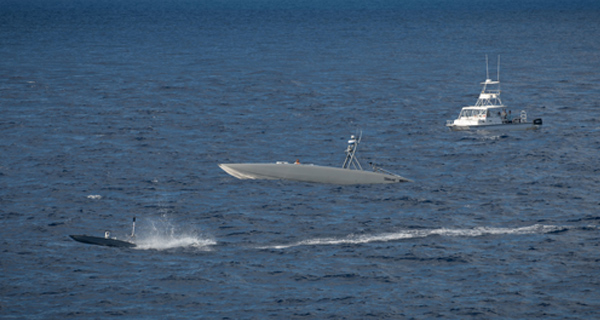
The new Autonomous Launch & Recovery Systems (ALARS) allows medium-sized USV to deploy and recover smaller USV, facilitating unmanned swarming missions.

Melbourne, FL— On 2/24/2025, Maritime Tactical Systems, Inc. (MARTAC), an innovator in Unmanned Surface Vessels (USVs), along with Sealartec, Inc. (Sealartec), an innovator in Autonomous Launch & Recovery Systems (ALARS), is proud to unveil a fully Autonomous Launch & Recovery System, whereby MARTAC’s MANTAS T8 (2.5 m) and T12 (3.6 m) Systems can be autonomously launched and recovered from MARTAC’s Devil Ray T38 (11 m) System.  It is widely recognized that the ability to autonomously launch and recover USVs is a critical factor in facilitating swarming missions and harnessing the full potential of unmanned systems in the marine domain.  Achieving this in relevant sea conditions with minimal reliance on human intervention, while ensuring speed and repeatability, is essential.

The ALARS capability allows for the autonomous launch and recovery of MARTAC’s USVs in up to sea state four and is deliverable as an add-on system requiring minimal modifications to the Devil Ray USVs.  Fully integrated within the Devil Ray main control system, the ALARS operates through Sealartec’s advanced Local Positioning System (LPS), which accurately identifies the MANTAS T12’s position during recovery. This enables precise and efficient capture, followed by automated loading and securing of the MANTAS T12 onto the Devil Ray T38, allowing the Devil Ray T38 to resume its mission at unmatched speeds.  The ALARS is flexible with a modifiable cradle allowing for other UxV systems to be launched and recovered from Devil Rays.

Bruce Hanson, MARTAC’s CEO said “Launching this ALARS takes us a step closer to realizing the ability to deploy and autonomously operate USV fleets capable of performing complex missions over large areas.  In general, UxVs represent high value payloads because they expand mission possibilities and endurance.  Early when we discussed missions with end-users, we recognized the value in autonomously launching the MANTAS from our Devil Rays as a force multiplier in support of integrated manned and unmanned operations.  Combining this ALARS capability with our Advanced AI Autonomy allow us to deploy USVs at scale to perform fully autonomous missions hundred or even thousands of miles away from personnel.  It is truly autonomous. This ALARS is available now and MARTAC and Sealartac are building out our capacity to scale for 2025.”

Amitai Peleg, Sealartec’s CEO said, “We are the leader in the ALARS market and this cutting-edge solution underscores Sealartec’s commitment to redefining operational efficiency and autonomy in the maritime domain.  As the USV market continues to grow, we see these ALARSs as essential in continued adoption and gaining user trust in USVs.”

MARTAC’s USV Solutions are truly turnkey NOW to address customers’ missions and use cases.

To see a short video of the ALARS in action, please visit our YouTube channel at:

https://www.youtube.com/@maritimetacticalsystemsinc9658

Maritime Tactical Systems Inc. (MARTAC) is the worldwide leader in the development and manufacture of Unmanned Surface Vessel (USV) Solutions.  MARTAC has a proven track record with thousands of hours operating worldwide and is the solution to your maritime mission needs.

Sealartec Inc. (Sealartec) is the worldwide leader in Autonomous Launch & Recovery Systems.  ALARS are critical to unlocking the future of marine autonomous systems.  Sealartec continuously invests in ALARS research and development creating real operational systems that can recover any unmanned or manned vehicle to its hosting platform in the most demanding sea state environment.

Optimizing for the Contested Logistics Mission: The Role of Maritime Autonomous Systems

The U.S. Marine Corps has spent more than 75 years honing the ability to assault a heavily defended beach, beginning with the famed island-hopping campaigns in the Pacific during World War II. In that time, the service has updated its tactics, techniques, and procedures and embraced new technology to maximize the success of these assaults and minimize the loss of sailors and Marines.

Far less attention has been paid to what happens after the initial assault. Enabling Marines to move beyond the beach depends on the assaulting force being able to provide continuous contested-logistics support. Unlike armies in a land campaign, during which various vehicles can provide this support, the expeditionary strike group’s ships must deliver everything Marines need to sustain the fight. Until the Marine Corps can devise a way to do so without unsustainable losses, the assaulting force will never have the weapons, fuel, food, and gear it needs to move inland. Autonomous surface vessels could provide a solution.

Read the full article here

Optimizing for the Contested Logistics Mission: The Role of Maritime Autonomous Systems

The U.S. Marine Corps has spent more than 75 years honing the ability to assault a heavily defended beach, beginning with the famed island-hopping campaigns in the Pacific during World War II. In that time, the service has updated its tactics, techniques, and procedures and embraced new technology to maximize the success of these assaults and minimize the loss of sailors and Marines.

Far less attention has been paid to what happens after the initial assault. Enabling Marines to move beyond the beach depends on the assaulting force being able to provide continuous contested-logistics support. Unlike armies in a land campaign, during which various vehicles can provide this support, the expeditionary strike group’s ships must deliver everything Marines need to sustain the fight. Until the Marine Corps can devise a way to do so without unsustainable losses, the assaulting force will never have the weapons, fuel, food, and gear it needs to move inland. Autonomous surface vessels could provide a solution.

Read the full article here