
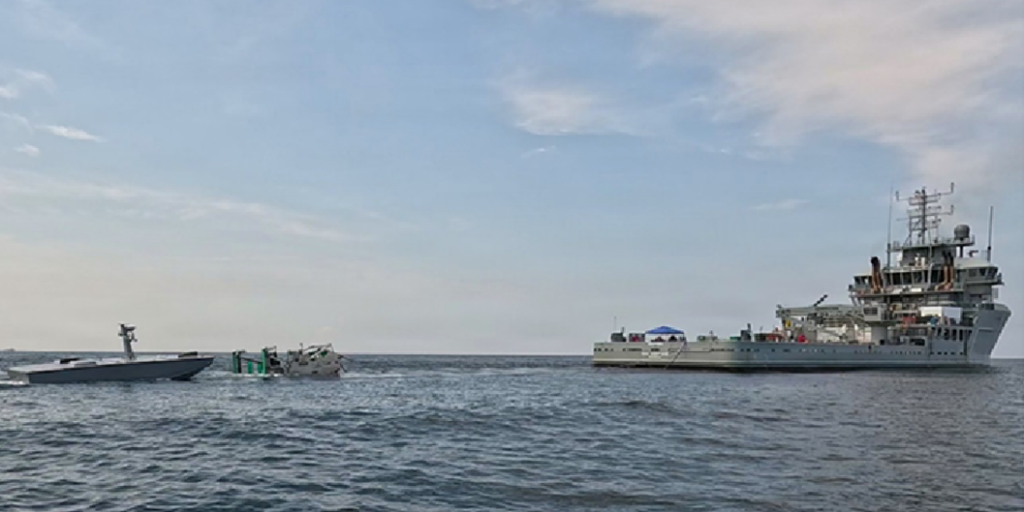
Seven months after the concept was first put on paper, a joint Navy-industry team has refueled an unmanned surface vessel (USV) at sea, a first, and one delivered on a timeline that conventional development and contracting paths do not produce. MARTAC, the Naval Air Warfare Center Weapons Division (NAWCWD) Blue Water Instrumentation (BWI) program and Sealartec worked as a single integrated team, backed by contracting authorities built for speed. The pace, and the partnership that enabled it, are as significant as the technical milestone itself.
During the August 11 demonstration in waters off Joint Expeditionary Base Little Creek-Fort Story, Virginia, a Navy-owned MARTAC Devil Ray® T38 was repeatedly captured, refueled and released while underway using Sealartec’s towable capture and connection device (TCCD), a robotic refueling system towed astern of the training support vessel USNS Vindicator (TSV 5). The team ran dozens of full-cycle capture, refuel and release evolutions at sea that day, in addition to pier-side events, and transferred a total of 400 gallons of fuel. Across the days leading up to and including the demonstration, the system completed approximately 100 connection cycles.
The operator-assisted demonstration was sponsored by U.S. Fleet Forces Command, Naval Surface Warfare Center Dahlgren Division and Naval Surface Warfare Center Carderock Division, and brought together BWI, BWI’s Future Capabilities Office fleet management team, MARTAC and Sealartec. The Littoral Combat Ship Mission Modules Program Office (PMS 420) and the Navy’s Portfolio Acquisition Executive for Robotics and Autonomous Systems provided the contracting support that let BWI partner directly with both companies; MARTAC delivered against the timeline in part because of its Naval Sea Systems Command Production Other Transaction Authority (P-OTA). That structure, government and industry engineers, operators and program leadership on the same water, at the same time, is what compressed seven months of development into demonstrated capability.
Leaders from each organization weighed in with some key insights:
“Working directly with our industry partners allowed us to bring the platform, control systems, operators, and engineers together as one integrated team. We could make changes, test them on the water, and iterate quickly based on what we observed,” said Spencer Holloway, director of BWI’s Future Capabilities Office.
Karl Van Deusen, MARTAC’s Senior Vice President for Federal Business Development & Government Relations, credited the government team and Sealartec for the outcome. “Testing together in an operational environment allowed the team to identify improvements, apply lessons learned and refine future concepts of operation for unmanned maritime systems,” Van Deusen said. “MARTAC’s contractual relationship with BWI is a model for how industry and government can learn and iterate together at speed. Our hats are off to Spencer Holloway and his team.”
“At industry conferences, we hear a lot of talk about how defense organizations want to adapt to the rapid pace of technology by streamlining procurement and operating more like agile startups,” said Amitai Peleg, CEO of Sealartec. “BWI didn’t just talk about that mindset; they demonstrated it.”
Following extensive market research, NAWCWD selected the Devil Ray T38 for its stability and endurance. Where competing platforms fell short on sea-state stability, the T38’s patented catamaran hull form held the line — providing both the steady sensor platform BWI needs for range instrumentation and the precise alignment the TCCD requires to capture and connect. That stability is what made repeated underway refueling achievable, and it makes the Devil Ray the first USV to demonstrate at-sea refueling in an operational environment.
Next Steps
Every time an unmanned vessel has to return to port for fuel, the fleet loses coverage. At-sea refueling breaks that constraint, converting the USV from a sortie-limited asset into a persistent one, and extending the reach of distributed maritime operations without adding crewed support ships or putting sailors into higher-threat waters.
“At NAWCWD, our immediate focus is supporting hypersonic and precision long-range fires testing, where flight profiles can extend thousands of miles beyond fixed-range boundaries and require data-collection assets to be distributed across a vast area,” Holloway said. “But the underlying challenge applies more broadly, every time an unmanned vessel must return to port for fuel, we lose persistence, reduce coverage and redundancy, and interrupt the mission.”
Ronald Raymer, branch head for capability, innovation, science and technology integration at U.S. Fleet Forces Command, took part in the demonstration and framed the fleet-level payoff. “This will allow us to have greater reliance on unmanned vessels instead of manned, and we can push the USV into higher threat areas without risking manned vessels and personnel,” Raymer said. “It will also allow us to distribute greater capability into an area without having to invest in large expensive manned vessels and the refueling supports that.”
BWI’s next milestone is an end-to-end autonomous refueling demonstration that treats vessel rendezvous and approach, capture, fuel transfer, disconnection and return to mission as a single evolution.
“The immediate work has two parts: Reducing command-and-control latency to improve precise maneuvering during operator-assisted testing and integrating next-generation local positioning systems to aid in autonomous refueling,” Holloway said.
Sealartec is developing the TCCD toward a fully autonomous architecture in which the USV approaches the refueling device, communicates via automated protocols and guides itself into position using maneuvering algorithms, removing the operator from the loop.
The step after that is refueling across distance. Seamus Flatley, MARTAC’s Chief Growth Officer and a former naval aviator, drew the parallel to carrier aviation, where airborne tankers extend the range and endurance of the air wing. “Applying this same type of capability to lengthen the range and endurance of unmanned platforms extends the reach and lethality of a hybrid fleet,” Flatley said.